Loosening Up The Page: Warm-Ups That Reduce Pressure
Gentle exercises to start moving
A blank surface often feels like a test. Simple warm-ups help treat it more like a playground. Instead of aiming for a “good picture,” the aim is simply to move the pencil and get used to the paper.
Fill part of a page with lines. Begin with straight strokes in one direction, then cross them at different angles. Draw from your shoulder as well as your wrist to feel how your whole arm changes the mark. Vary speed and pressure: slow and firm, then quick and light. These marks do not have to look tidy.
Curves are just as useful. Draw small circles and ovals, then larger ones that reach toward the edges. Let them overlap and wobble. The purpose is smoother motion and less concern about “saving” space. After a few minutes, the page already looks used, which makes it easier to add a small study or doodle.
Turning warm-ups into small games
Adding a bit of play can lower tension even more. Choose one object nearby, set a short timer, and draw it with loose, continuous lines until the timer ends. Then stop, turn the page or shift your view, and start another tiny version. Quick sessions like this can make irregular lines feel normal instead of like mistakes.
Limiting tools also helps. Use a single pen or a slightly dull pencil for several spreads of loose marks, scribbles, and quick gesture drawings of objects or simple poses from memory. With fewer choices, attention naturally moves to motion and observation rather than judging results. Over time, these short sessions can make a drawing notebook feel like a safe place to explore rather than something that has to impress anyone.
| Warm-up approach | Main focus | When it helps most |
|---|---|---|
| Pages of straight lines | Hand–eye control, steadiness | Before careful studies of buildings or boxes |
| Circles and ovals | Smooth motion, curved strokes | Before drawing faces, plants, or round items |
| Timed continuous sketches | Letting go of perfection | When fear of “ruining the page” shows up |
Exploring Light And Shadow In Simple Ways
Practicing with basic forms
Shading often feels confusing when the direction of light is unclear. A sketchbook drill is to choose one light direction and keep it the same across a page.
Lightly draw a row of simple shapes: a sphere, a cube, a cylinder, a cone. Pick one corner of the page as the “light source” and mark it with a tiny arrow. On every shape, the side facing that arrow stays light, and the opposite side becomes dark.
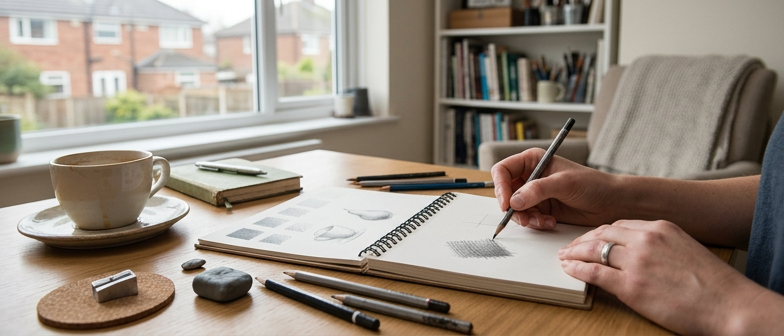
Begin with just three tones: light, medium, and dark. Fill the darkest side, add a softer middle band, and leave a small area nearly white. Repeat the same row with the light coming from another corner. After a few repetitions, the way shadows bend around forms starts to feel more familiar.
You are not aiming for dramatic effects, just a clearer sense of where to place darker and lighter areas so a flat outline starts to look solid.
Turning everyday items into quick drills
Once basic forms make more sense, common objects can become compact light-and-shadow studies. Choose something with a clear overall shape, such as a cup, a piece of fruit, or a folded cloth. Place it so that one main light source is strongest, which creates obvious light and dark areas.
On the page, draw the outline of the object several times in a row. Give each version a specific role: one focusing on the darkest cast shadows and creases, one on gentle mid-tones, and one on highlights and reflected light. Keeping each pass brief allows you to repeat the subject without getting stuck on one attempt.
Try varying pressure with the same pencil rather than switching tools. A lighter touch can suggest soft transitions, while a heavier hand shows deeper shadow. A few minutes of this kind of practice on most days can gradually make volume and depth feel more natural to draw.
| Shading drill type | What you practice | Helpful reminder |
|---|---|---|
| Rows of simple forms | Consistent light direction | Keep one corner as the “light source” |
| Repeated outlines of one object | Breaking shading into small tasks | One version for darks, one for tones |
Everyday Objects As Supportive Practice Partners
Everyday items work well for practice because they are already nearby and stay still. A small area on a table or desk is often enough to arrange three to five things into a simple study.
Look for clear shapes: a mug, a small plant, cutlery, tape, scissors, a notebook, or a bottle. Place one taller item in the back, a medium one in the middle, and a smaller one in front so they overlap slightly. This creates depth without requiring complex perspective.
Try changing just one aspect at a time. Move a single object, switch the angle, or adjust the spacing. Each minor change gives a fresh view while keeping the setup familiar.
If colour feels like too many decisions, keep to one pen or pencil and possibly a very light wash or hatch for tone. That keeps attention on size, angle, and placement rather than matching hues or finishing a polished piece.
Loose themes can add variety. A “morning” corner might mix a cup, a spoon, and a small container. An “art tools” group could be a pencil, an eraser, a sharpener, and a folded tissue. A “bag dump” could combine keys, notes, and small gadgets. The theme is only there to suggest options.
Repeating a theme for several days and swapping just one element can be useful. The repeated shapes help hand and eye coordination, while small changes prevent boredom. Scraps, such as packaging, receipts, or leftover materials, also make quick arrangements that fit into short breaks and slowly fill a sketchbook with relaxed studies.
Building A Gentle, Sustainable Drawing Rhythm
Starting small and staying flexible
A steady sketch habit often works best when it is modest and predictable. Choose a brief moment that already exists in your schedule, such as during a drink break or just before going to sleep. Give that slot a simple task: spend a few minutes with your drawing notebook. The goal is to show up, not to finish a full page or complete scene every time.
To keep decisions light, consider having a weekly focus instead of changing topics every day. One week could centre on simple lines, circles, and boxes. Another might focus on small motifs like leaves, stars, waves, or simple icons. Repeating similar marks lowers the barrier to starting, because you already know what kind of drawing you will do.
Keep materials minimal: a compact sketchbook and one favourite pen or pencil that can live in your bag, on your desk, or by your bed. When tools are close at hand, short sessions become easier to fit into spare moments.
Quick prompts that fit into a busy day
Thinking in small “tiles” rather than full pages can be freeing. Lightly divide a page into three or four rectangles and treat each one as its own tiny scene. Filling just one box can still feel like a complete session.
Possible low-pressure prompts include:
- A narrow slice of a room: part of a chair, a plant, a lamp, or a stack of books
- A single item from your desk built from basic shapes first, then refined
- Tiny pattern tiles featuring stripes, dots, spirals, or checkerboard-like grids
Try to see each drawing as a short experiment in noticing shapes, angles, and light rather than as a test of overall talent. Some sketches will look awkward, and that is part of the process. Those pages still serve their purpose by keeping your hand moving and your eye engaged.
Over time, these small, repeatable practices can turn a new sketchbook from something that feels fragile into a comfortable place to explore. Lines become steadier, shading makes more sense, and familiar objects start to reveal interesting details you might not have noticed before.
Q&A
-
What are some effective beginner sketchbook practice ideas to avoid fear of the blank page?
Choose “throwaway” pages for experiments, such as texture swatches, small thumbnail boxes, or quick diagram notes about objects instead of polished pictures. Mix in margin doodles from meetings, draw tiny map fragments of places you know, or copy shapes from packaging. Treat the sketchbook as a visual notebook, not an art gallery. -
How can I build a daily drawing habit without it feeling like a chore?
Attach drawing to an existing routine, like coffee, commuting, or winding down at night, and keep the session deliberately short so it feels easy to complete. Decide tomorrow’s tiny task before you close the book. Track streaks on a calendar, but celebrate consistency, not quality, to prevent perfectionism from breaking the habit. -
What are simple pencil shading basics I should master first?
Start with a consistent grip and angle so the pencil touches the paper evenly, then practice three-value scales using only pressure changes, not extra tools. Explore hatching in one direction before adding crosshatching, and learn to keep highlights as untouched paper. Focus on smooth transitions, not detail, to build control and confidence. -
Which creative observation exercises help me see like an artist?
Try daily “shape hunting,” where you reduce complex objects into circles, boxes, and wedges, and gesture not their outlines but their tilt and weight. Do blind-contour sketches to train attention, and set mini-missions like spotting three interesting shadows or reflections a day, then summarizing them in fast, labeled sketches. -
What confidence building drawing prompts are good for a gentle art routine planning guide?
Include prompts you almost cannot fail at: draw messy shadows only, objects as simple icons, or five-second gesture scribbles. Alternate “comfort” prompts, such as repeating familiar mugs, with one small stretch prompt weekly. Plan check-ins each month to notice progress instead of flaws, reinforcing a kinder, sustainable relationship with drawing.