Why Practice Watercolor Color Mixing
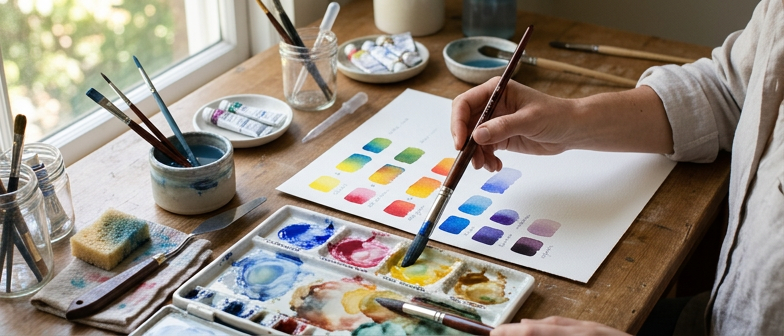
Practicing watercolor color mixing helps beginners move beyond copying colors from a palette and start understanding how paints actually behave. When you treat regular Watercolor Color Mixing Practice as part of your routine, you see how different pigments react with water, paper, and one another instead of guessing. Simple beginner watercolor exercises, like filling small swatches with mixed hues or building a basic color chart, reveal how transparent or opaque a color is and how strongly it stains the paper. This familiarity makes it easier to predict what a wet brush will do on the page, so your decisions feel intentional rather than random.
Intentional mixing also builds confidence and control, which makes painting feel less frustrating and more enjoyable. As you repeat small, focused Beginner Watercolor Exercises, such as blending two paints to match a reference color, you sharpen your eye for changes in hue and value. Over time, these practices teach you how much water to add, how many layers to use, and how to rescue a mixture that looks too dull or too bright. Instead of avoiding complex subjects because the colors seem intimidating, you can approach them knowing you have practiced the underlying skills.
Building a Simple Watercolor Color Wheel
A simple watercolor color wheel is a practical way to see how your paints interact and to build confidence with basic paint mixing. Lightly draw a circle and divide it into twelve equal sections, like a clock. Choose three clearly distinct primary paints, such as a bright yellow, a strong red, and a clear blue, and label these sections so you remember which color is which. This wheel becomes a reference for later watercolor color mixing practice and other beginner watercolor exercises.
Begin primary color blending by placing yellow, red, and blue in alternating spaces around the circle, leaving gaps between them for mixtures. Mix yellow and red for orange, red and blue for violet, and blue and yellow for green, filling the gaps between each primary. Vary the ratio of each color to see how the mixtures shift, and keep the paint creamy rather than overly watery so the colors dry evenly. As you work, you can observe how clean, direct mixtures differ from duller blends made with more complex combinations.
To complete the wheel, create tertiary colors by mixing each primary with its neighboring secondary and placing these hues between them on the circle. Notice which mixtures feel warm and which feel cool, and how shifting the balance of each primary changes the character of the color. You can also add more water to create lighter tints in a narrow band beside each segment, giving a gentle introduction to watercolor value practice. When you finish, you have a compact guide that supports future basic paint mixing and makes it easier to predict how two colors on your palette will behave together.
| Step | Action on Wheel | Purpose | Tip |
|---|---|---|---|
| Plan layout | Divide circle into twelve segments | Create even spacing for hues | Lightly sketch sections first |
| Place primaries | Position yellow, red, blue in a triangle | Anchor main hue points | Label each primary clearly |
| Mix secondaries | Fill gaps with orange, green, violet | Show direct primary mixtures | Keep mixes smooth and creamy |
| Add tertiaries | Insert mixes between primary and secondary | Reveal subtle hue shifts | Adjust ratios to explore variations |
| Note temperature | Mark warm and cool areas around wheel | Compare color temperature families | Observe which mixes feel warmer or cooler |
| Test values | Add lighter band beside each segment | Introduce basic value practice | Use more water for softer tints |
Primary Color Blending on the Wheel
To practice basic paint mixing on a watercolor color wheel, place your three primary colors in an even triangle around the circle, using warm and cool versions of yellow, red, and blue if you have them. Load each primary with enough water so it flows smoothly, then paint clean swatches at their positions, leaving gaps between them for mixtures. This layout lets you compare how each primary behaves in a consistent arrangement.
Blend neighboring primaries directly on the wheel to create secondary hues, mixing yellow with red for oranges, red with blue for violets, and blue with yellow for greens. Gradually adjust the ratios to show small shifts and to form tertiary steps between each pair. Label each segment lightly with the pigments or proportions you used so this beginner watercolor exercise becomes a clear record of your personal primary color blending choices.
Understanding Warm and Cool Color Families
In watercolor color mixing practice, artists group hues into warm and cool families to predict how paints behave when combined. Warm colors such as reds, oranges, and many yellows suggest sunlight or heat, while cool colors like most blues, greens, and some violets suggest shade, distance, or water. This division is not a strict rule, but a practical way to organize your palette so that basic paint mixing becomes more intentional instead of random experimentation.
Each primary color has both warm and cool versions, and this strongly influences your mixes. A warm yellow that leans toward orange creates bright oranges when blended with a warm red, while a cooler, more greenish yellow makes fresher greens when mixed with a cool blue. A red that leans toward violet mixes differently with blue than an orange-leaning red. Noticing whether a pigment bends toward a neighboring warm or cool hue helps you anticipate cleaner or more muted mixtures.
For beginner watercolor exercises, separate your paints into two rows on a test sheet, one labeled warm and the other cool, then create small swatches where each color is mixed with its neighbors. A simple watercolor color wheel based on this chart trains your eye to see temperature shifts and how they affect value and intensity. With practice, you will notice that different warm and cool pairings can either brighten a mixture or quickly dull it, giving you more control over primary color blending and subtle atmospheric washes.
Warm and Cool Mixing Exercises
For a simple beginner watercolor exercise on warm and cool colors, choose two warm primaries, such as a warm red and warm yellow, and two cool primaries, like a cool blue and cool yellow. Paint small swatches where you mix warm with warm in one row and cool with cool in another, adding different amounts of water so you can see both strong and diluted versions. As the washes dry, compare how the warm mixtures often appear more lively and saturated, while the cool combinations can look more subdued, even when you follow the same basic paint mixing steps.
Then mix warm and cool versions of the same primary colors to see how temperature shifts affect your watercolor color wheel or swatch chart. Pair a cool blue with a warm red, or a cool yellow with a warm blue, and notice how the resulting greens, purples, and oranges often lean gray or neutral rather than bright. This kind of watercolor color mixing practice trains your eye to spot subtle temperature changes and supports watercolor value practice, because you can also vary the lightness of each mixture while you build confidence with primary color blending.
Practicing Watercolor Values and Neutrals
Value practice in watercolor trains you to see how light or dark a color can be without changing its hue. To build a simple value scale, pick one paint, load your brush with a strong mix, and paint a small rectangle for the darkest step. For each new step, add a little more clean water to the same puddle and paint another rectangle, working toward a very pale wash. This kind of watercolor color mixing practice shows how far a single pigment can stretch from deep tone to delicate tint.
Controlling the water to paint ratio is at the heart of basic paint mixing. If your brush holds a lot of water and little pigment, the value will be light and transparent; if you blot the brush and reload with thicker paint, the stroke looks darker and more opaque. Practicing smooth transitions, such as a graded wash from dark to light, reveals how pressure, brush speed, and paper dampness affect value. Repeating these beginner watercolor exercises with different primary colors builds confidence before you attempt more complex subjects.
Once you are comfortable with value scales, explore neutral and muted colors without relying on black paint. A classic approach is to mix complementary hues, such as red with green or blue with orange, adjusting the ratio until the mixture looks greyed down rather than vivid. You can also soften a bright color by blending in a small amount of its opposite temperature, like introducing a cool blue into a warm orange. Working through these mixtures while watching the value helps you create subtle shadows, atmospheric backgrounds, and understated palettes.
Q&A
-
Why is regular watercolor color mixing practice important for beginners?
Consistent mixing practice shows how each pigment behaves with water and paper, so you stop guessing and start predicting shifts in hue, transparency, and staining. -
How do I build a simple watercolor color wheel with my primary paints?
Draw a circle, divide it into twelve slices, place your three primaries evenly around it, then fill the sections between them with their mixed secondary and tertiary colors. -
What are warm and cool color families in watercolor, and why do they matter?
Warm hues lean toward yellow or red and feel energetic, while cool hues lean toward blue and feel more distant; knowing this helps you choose mixes that support the mood you want. -
How can I practice mixing warm and cool primaries effectively?
Create small rows of swatches where you mix warm primaries together and cool primaries together, varying the water so you can compare rich and diluted versions as they dry. -
What is a simple watercolor value practice I can try with one color?
Paint a row of rectangles from dark to light by starting with a strong pigment mix, then gradually adding clean water to the same puddle for each lighter step.